


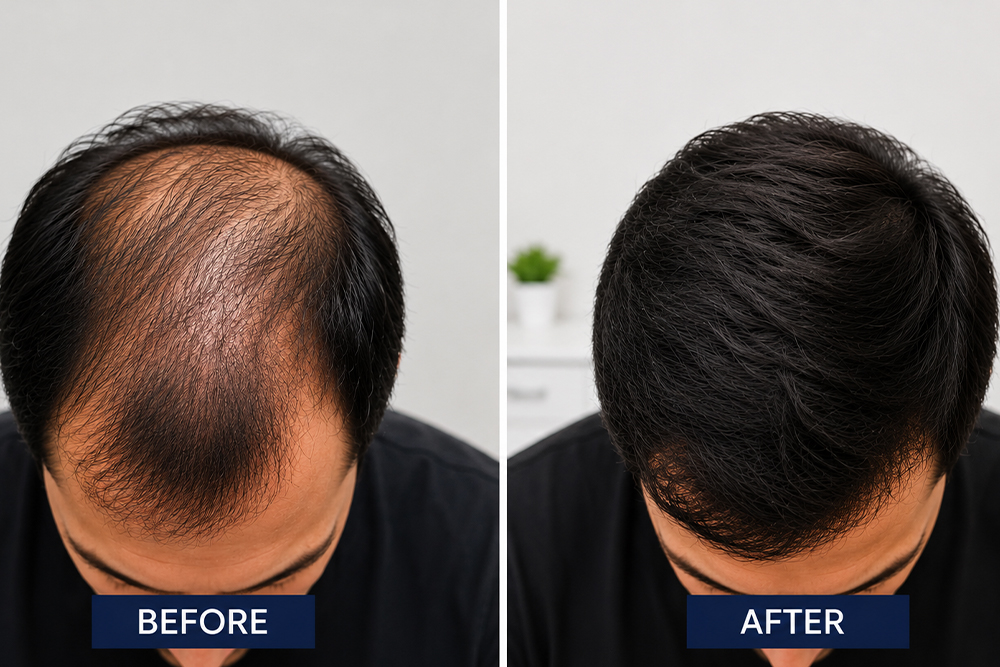
Hair Transplant Before and After Results – What to Expect from Hair Restoration in Delhi
Hair transplant surgery is one of the most searched topics among men and women dealing with significant hair loss and understandably so, because it is the only permanent solution for restoring hair to areas where the follicles have stopped producing hair entirely. But before deciding to undergo the procedure, most people want to know one thing above everything else what will the results actually look like, and will they look natural? Understanding hair transplant before and after results and what to realistically expect from hair restoration treatment in Delhi is one of the most important parts of making an informed decision. The results of a hair transplant when performed correctly by skilled doctors using the right technique should look completely natural. The hairline should blend with the existing hair, the density should be appropriate and realistic for the scalp area available, and the transplanted hair should grow, behave, and respond to trimming and styling exactly like natural hair. At Dadu Medical Centre, a trusted hair treatment clinic in Delhi, Dr. Nivedita Dadu guides patients through the entire hair transplant process from candidacy assessment and technique selection through to the post-operative healing phase and final result evaluation ensuring that each patient has a clear and honest picture of what their specific hair loss pattern can realistically achieve through transplantation. The clinic is located at Vasant Vihar in South Delhi and Rajouri Garden in West Delhi, and the assessment process before any hair transplant recommendation is thorough, personalised, and medically grounded.
To understand what before and after results look like in a hair transplant, it is important to first understand how the procedure works. Hair transplantation involves taking hair follicles from a donor area typically the back and sides of the scalp, which are genetically resistant to the DHT hormone responsible for pattern hair loss and implanting them into the recipient area where hair has thinned or stopped growing. The two primary techniques used today are FUT Follicular Unit Transplantation and FUE Follicular Unit Extraction. In FUT, a strip of scalp is removed from the donor area and the individual follicular units are dissected from it under magnification before being implanted. In FUE, individual follicular units are extracted directly from the donor area one by one using a small circular punch device, without removing a strip of scalp. FUE is the more popular technique today because it leaves no linear scar in the donor area only small circular marks that are not visible once the surrounding hair grows back. Both techniques produce permanent results because the transplanted follicles carry the genetic resistance to DHT from the donor area and retain this resistance even after being moved to the recipient area. The transplanted hair continues growing for the rest of the patient's life as normal hair.
The before and after journey of a hair transplant has a very specific timeline that every patient at the hair transplant clinic in Delhi at Dadu Medical Centre is briefed on thoroughly before the procedure. Immediately after the transplant, the recipient area looks red and there are small scabs around each implanted graft. This settles within one to two weeks. Between weeks two and six, a phase called shock loss occurs this is the phase that most surprises patients who are not prepared for it. The transplanted hairs fall out during this period, which is completely normal and expected. The hair follicles themselves remain alive under the scalp and are simply cycling into a resting phase before beginning new growth. By month three, early new hair growth begins emerging from the transplanted follicles. By month six, a significant and visible improvement in coverage is usually apparent enough that most patients feel comfortable having their hair cut and styled normally. The full and final result of the transplant is typically visible at twelve months, and in some patients with thick or slow-growing hair this may extend to fourteen or fifteen months. At one year post-transplant, the transplanted hair has grown to its full length and density, the hairline has matured, and the natural blending of transplanted and existing hair is at its best. This is what the final before and after comparison should be evaluated against not at three or six months.
The density and naturalness of the result depend significantly on several factors the number of grafts transplanted, the quality and density of the donor area, the technique used, the experience of the surgical team, and how well the patient follows post-operative care instructions. Most male patients with grade three to five hair loss on the Norwood scale are good candidates for a single transplant session of two thousand to three thousand five hundred grafts that covers the frontal zone and hairline effectively. More advanced hair loss may need a second session or a planned two-stage approach. For women with female pattern hair thinning, the candidacy assessment is more nuanced the donor area density and the pattern of thinning both need to be carefully evaluated before recommending transplantation, and many women benefit from combining non-surgical treatments like GFC, Advanced HGP, and mesotherapy with or instead of surgery depending on the degree of loss. Dr. Nivedita Dadu at Dadu Medical Centre conducts this assessment individually for every patient no two hair loss patterns are the same, and the right approach for one person may not be right for another. Honest guidance about whether a transplant will produce the result a patient wants or whether non-surgical treatment would serve them better at their current stage of loss is a core part of the consultation process.
After the transplant, post-operative care directly affects the quality of the final result. In the first week, the scalp should be kept clean and the grafts should not be disturbed no direct water pressure, no scratching, and no strenuous activity. The small scabs around the grafts should be allowed to fall off naturally over ten to fourteen days. From week three onwards, normal washing and light activity can gradually resume. Sun exposure on the scalp should be avoided for the first three months. The hair fall doctors in Delhi at Dadu Medical Centre schedule follow-up visits at one month, three months, six months, and twelve months to monitor the growth progress, assess the health of the transplanted follicles, and recommend any supplementary treatments such as GFC sessions or mesotherapy to support the growth phase of the transplanted hair and maintain the density of the existing non-transplanted hair.
Hair Transplant Timeline – Before and After at Each Stage
Timeframe | What the Scalp and Hair Look Like | What to Expect |
Immediately After Procedure | Red scalp, small scabs around each graft | Normal post-procedure appearance, no cause for concern |
Week 1 – 2 | Scabs settling, mild swelling possible | Scabs fall off naturally, scalp looks cleaner |
Week 2 – 6 (Shock Loss) | Transplanted hairs shed looks similar to before | Normal and expected follicles are alive beneath scalp |
Month 3 | Early fine new growth begins emerging | First visible sign of result beginning |
Month 6 | Significant coverage in transplanted zones | Hair can be cut and styled, most patients see clear improvement |
Month 9 – 10 | Hair thickens and hairline becomes more defined | Results looking very good for most patients |
Month 12 | Final, mature result fully visible | Best evaluation of before and after comparison done here |
Month 14 – 15 | Full maturation for slower-growing hair | Maximum density and naturalness achieved |
Shock loss between week two and six is normal and temporary it does not indicate a failed transplant.
Hair Transplant Candidacy – Who Gets the Best Before and After Results
Patient Profile | Transplant Suitability | Expected Result Quality |
Men with Grade 3 – 5 Norwood hair loss, stable for 1+ year | Excellent candidate | Natural hairline, good frontal density achievable |
Men with Grade 6 – 7 Norwood loss | Possible but limited by donor supply | Partial coverage, may need staged approach |
Women with female pattern thinning | Requires careful evaluation | Good results if donor area is dense and loss is stable |
Patients with adequate donor hair density | Best outcomes | Higher graft yield, better coverage |
Patients whose hair loss is still actively progressing | Not ideal timing | Recommended to stabilise with non-surgical treatment first |
Patients with scarring alopecia | Case-by-case assessment | Technique modified based on scar tissue condition |
Patients with beard or body hair as supplement | FUE with body hair possible | Useful for large bald areas with limited scalp donor |
Candidacy is always confirmed through an in-person consultation and trichoscopy assessment by the doctor.
FUT vs FUE Hair Transplant – Comparison for Before and After Planning
Feature | FUE (Follicular Unit Extraction) | FUT (Follicular Unit Transplantation) |
Extraction Method | Individual grafts extracted one by one with small punch | Strip of scalp removed and follicles dissected from it |
Donor Area Scarring | Tiny circular marks, not visible with short hair | Linear scar at back of scalp, visible if hair very short |
Number of Grafts Per Session | Typically 1,500 – 3,500 per session | Can yield higher graft counts in one session |
Recovery Time | 7 – 10 days | 10 – 14 days, strip site needs additional healing |
Suitable For | Patients wanting short hairstyles, smaller sessions | Patients needing large graft counts in a single session |
Naturalness of Result | Excellent same as FUT when done well | Excellent same as FUE when done well |
Graft Quality | Very good with experienced team | Very good allows careful dissection of grafts |
Preferred By Most Patients | Yes due to no linear scar | Selected when large session size is needed |
Both techniques produce permanent, natural-looking results when performed by experienced hair restoration surgeons.
Comments (0)
Loading comments...