


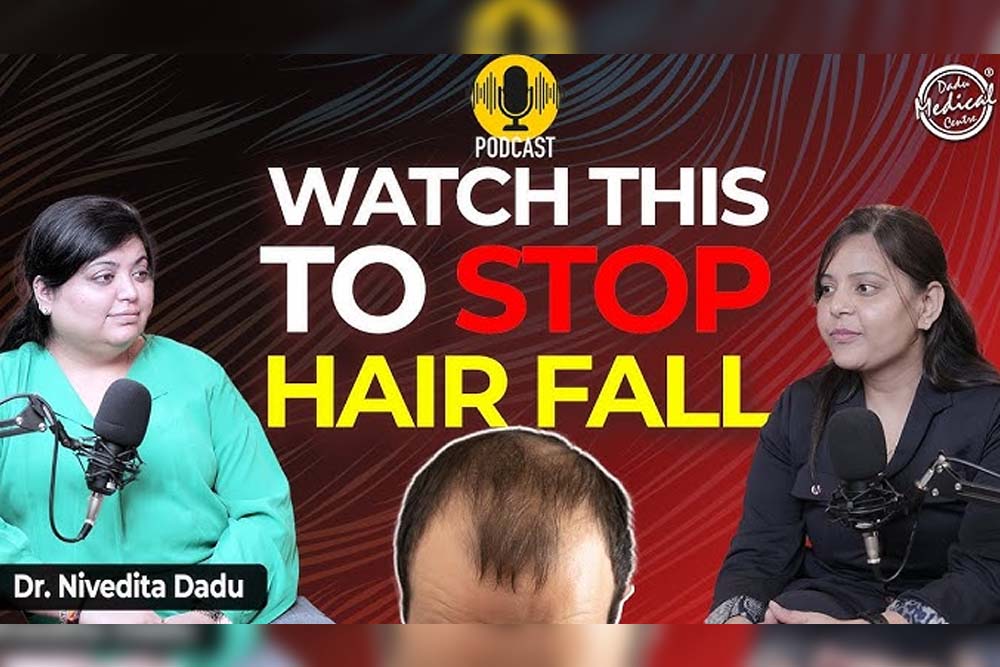
Hair Fall Q&A: Dr. Nivedita Dadu Separates Myths From Facts
Hair Fall Q&A: Dr. Nivedita Dadu Separates Myths From Facts
Hair fall is easily one of the most common concerns people bring up, whether they're noticing a widening parting or simply feel their hair isn't as thick as it used to be. In this conversation, we sat down with Dr. Nivedita Dadu to go through the questions that come up again and again from what's actually causing the hair fall to whether whey protein or minoxidil are safe to use. If you've been searching for a reliable hair clinic in Delhi and want real answers instead of Instagram myths, this should clear up a lot.
What Are the Different Types of Hair Fall?
According to Dr. Dadu, hair fall isn't a single condition it shows up in several distinct forms. The kind that follows childbirth, COVID, dengue, typhoid, or a major surgery is called Telogen Effluvium. It's essentially the body's reaction to sudden stress, where nutrients stop reaching the hair follicles properly for a while.
Then there's hormonal hair fall, which looks different depending on gender. In women, it shows up as overall thinning and a drop in hair texture and quality. In men, it's usually a receding hairline and a broadening forehead compared to a few years earlier.
Beyond that, there's Alopecia Areata, an autoimmune condition that causes coin-shaped bald patches on the scalp, eyebrows, or beard. And then there's Scarring Alopecia, where the hair root itself is destroyed, making regrowth extremely difficult. This is exactly why consulting a dermatologist in Delhi early matters getting the right diagnosis determines whether treatment can actually work.
Does Smoking Really Affect Hair Fall?
Yes, according to Dr. Dadu, and there are multiple reasons behind it. Smoking increases free radical damage and oxidative stress, which directly damages hair follicles. It also shrinks blood vessels, cutting down blood supply and nutrients reaching the scalp. On top of that, smoking slightly raises androgen levels in the blood, which can worsen male pattern baldness in people already prone to it.
Is Male Pattern Baldness Linked to High Testosterone?
Not necessarily. Dr. Dadu clarified that male pattern baldness isn't about having more testosterone it's about how much testosterone converts into DHT through an enzyme called 5-alpha reductase. Some people simply have higher levels of this enzyme, more DHT, or more receptors that DHT binds to, and genetics is by far the most common reason behind this. A family history of baldness is usually the strongest predictor.
Why Are Men Losing Hair Younger Than Their Fathers Did?
This is something Dr. Dadu hears constantly fathers who started balding at 40 or 45, while their sons are dealing with the same thinning at 20. Genetic predisposition plays a role, but it's rarely the only factor. Stress levels, poor sleep, smoking, post-COVID hair fall, and vitamin deficiencies are all pushing hair loss to a much younger age today.
Does Whey Protein Cause Hair Fall?
This is a myth Dr. Dadu wanted to bust directly whey protein by itself has no direct link to hair fall or hormonal hair thinning. The confusion usually comes from what people take alongside it. If whey protein is combined with creatine, certain amino acids, anabolic steroids, or separate testosterone supplementation, hair fall can definitely increase. But that's the added substances at play, not the whey protein itself.
What About the Masturbation Myth?
Another common worry among younger patients, and Dr. Dadu was clear that there's no scientific evidence linking masturbation to hair fall. The idea that semen loss depletes protein needed for hair density is purely a myth with no real correlation.
Minoxidil: Should You Just Start Using It Yourself?
Minoxidil is widely available and genuinely effective at increasing density, but Dr. Dadu strongly advises against self-prescribing it. In the initial phase, minoxidil pushes hair that's already in the shedding phase to fall out faster before new growth begins and without medical guidance, this can feel alarming enough that people quit right when it starts working. It comes in gel, lotion, alcohol-based, and alcohol-free formulations, and newer versions combine it with peptides, procapil, or even finasteride. A proper scalp evaluation by doctors in Delhi helps determine if you're even a suitable candidate before starting.
Minoxidil Formulations at a Glance
Formulation | Best For |
Alcohol-based lotion | Standard use, faster drying |
Alcohol-free formulation | Sensitive or dry scalps |
Peptide-combined minoxidil | Added scalp strengthening support |
Combined with Finasteride | Cases needing DHT-blocking support too |
Oral minoxidil | Those who can't apply topical products regularly |
Oral Minoxidil Is It Worth Considering?
Oral minoxidil is gaining popularity and, per Dr. Dadu, tends to show more consistent results than the topical version simply because it's more practical no daily application needed. That said, it should only be taken under a doctor's supervision after proper scalp assessment and relevant blood tests, since the same initial shedding phase applies here too.
Is Finasteride Actually Safe?
Finasteride carries a reputation for side effects that scares many people away, but Dr. Dadu pointed out that studies show around 97% of users experience no side effects at all, with only about 3% reporting issues most of which are reversible once the medication is stopped. It works by blocking the 5-alpha reductase enzyme, preventing testosterone from converting into DHT, which is what stops the hair fall in the first place. The side effects that do occur are mostly sexual reduced libido, lower sperm count, or premature ejaculation and these typically resolve after stopping the medication.
From PRP to Exosomes: How Hair Fall Treatments Have Evolved
Dr. Dadu walked through how treatment in Delhi for hair fall has progressed over the years. PRP, or Platelet Rich Plasma therapy, was the starting point blood is drawn, platelets separated, and injected back in. GFC (Growth Factor Concentrate) improved on this by extracting the growth factors from those platelets and injecting them directly, giving better results than plain PRP.
QR678 goes a step further it's a cocktail of growth factors, stem cells, and hair-boosting peptides that doesn't need blood at all, with injections so superficial the treatment is almost painless. And the newest addition, Exosome therapy, is considered even more superior it uses stem cell-derived vesicles, requires no blood draw, no injections at all (just a derma pen), and needs far fewer sessions than PRP for similar or better results.
Evolution of Hair Fall Treatments
Treatment | Blood Required | Delivery Method | Relative Effectiveness |
PRP | Yes | Injection | Baseline |
GFC | Yes | Injection | Better than PRP |
QR678 | No | Superficial injection | Superior to PRP & GFC |
Exosomes | No | Derma pen (no injection) | Most superior of all |
Which Hair Fall Type Needs What Approach
Hair Fall Type | Common Cause | Typical First Step |
Telogen Effluvium | Post-illness, surgery, delivery, stress | Nutrient support, scalp evaluation |
Hormonal Hair Thinning | Genetics, DHT, hormones | Minoxidil / Finasteride, consult dermatologist |
Alopecia Areata | Autoimmune | Dermatologist-guided treatment |
Scarring Alopecia | Follicle destruction | Early diagnosis critical |
Dr. Dadu was clear on one final point these treatments work across genders and across every type of hair fall, whether it's telogen effluvium, hormonal thinning, or pattern baldness in men or women. The key, as always, is getting a proper diagnosis first rather than self-treating based on what's trending online. If your hair fall feels unusual or isn't improving, it's worth consulting a specialist at a proper skin clinic in Delhi rather than guessing.
Frequently Asked Questions (8)
Q1. What is Telogen Effluvium?
Ans:- It's a temporary hair fall triggered by stress events like illness, surgery, or childbirth, where nutrients stop reaching hair follicles properly.
Comments (0)
Loading comments...