


Signs of a Bad Hair Transplant — And How Celebrities Got Theirs Fixed
If you have ever looked at a celebrity and thought something looks off about their hair, the hairline sits too straight, the density looks unnatural, or the whole thing just does not look like real hair there is a good chance you were looking at a hair transplant repair job that was not done well the first time. Failed or poorly executed hair transplant treatment in Delhi and across the world is more common than most clinics will admit, and some of the most recognisable faces in the world have had to go back and get their first procedure corrected by a more experienced specialist.
This is not a rare or unusual situation. Hair transplant repair also called revision hair transplant surgery is an entire speciality within hair restoration. It exists specifically because a significant number of transplants are done poorly the first time, leaving patients with results that look worse than their original hair loss did. The good news is that a bad transplant can almost always be corrected. The key is finding the right doctors in Delhi or wherever you are located, specialists who have the skill and experience to undo someone else's mistake and deliver the natural result the patient should have had from the beginning.
What Does a Failed Hair Transplant Actually Look Like?
Before we get into the celebrity stories, it is important to understand what a bad hair transplant looks like because not everyone can spot one immediately. Here are the most common signs:
The Doll Hair Effect: This is the most obvious and most talked-about sign of a bad transplant. It happens when hair grafts are implanted in perfectly straight rows with uniform spacing between them, creating a look that resembles the hair on a plastic doll rather than natural human hair. Natural hair does not grow in perfectly spaced rows it grows in clusters of different sizes at varying angles.
An Unnaturally Straight Hairline: A natural hairline is never perfectly straight. It has micro-irregularities, small variations in density, and a gradual transition from forehead skin to hair. A transplant that creates a ruler-straight line across the forehead looks immediately and obviously artificial especially under camera lighting and in high-resolution photographs.
Visible Scarring: Poor FUT technique or a surgeon who took too wide a strip from the donor area leaves a thick, visible linear scar across the back of the head. This becomes a serious problem when the patient wants to wear their hair short.
Patchy or Uneven Density: When grafts are not distributed evenly or when a significant percentage of transplanted follicles fail to survive, the result is an uneven, patchy look with obvious dense areas next to obviously thin areas.
Pluggy Appearance: Older transplant techniques used large grafts called plugs that were implanted in groups. These create a very unnatural clustered look that is immediately recognisable as a hair transplant to anyone who looks closely.
Shock Loss Without Recovery: Some degree of shock loss where surrounding natural hair falls out temporarily due to surgical trauma is normal after a transplant. But when it is severe and the hair does not return, it leaves the patient with less hair than they started with.
Wrong Hairline Design for the Face: A technically competent transplant can still look wrong if the hairline was designed without proper consideration of the patient's age, face shape, and long-term hair loss progression. A hairline designed for a 25-year-old face on a man who will continue losing hair looks increasingly wrong as the years go on.
Celebrity Cases — Publicly Documented Poor Results and Corrections
1. Wayne Rooney — The Most Honest Celebrity Hair Journey
Wayne Rooney is without question the most publicly documented celebrity hair transplant case in the world. He went public about his first procedure in 2011 and posted about it openly on social media something almost no celebrity had done before him. His willingness to talk about it openly was genuinely groundbreaking and helped normalise the conversation around male hair loss and transplant procedures.
However, what followed over the next few years showed very clearly that a single transplant session is not always the end of the story. Rooney's hair loss continued progressing after his first procedure which is one of the most common reasons revision sessions become necessary. When the underlying hair loss is not fully stabilised and the transplant plan does not account for future recession, the result can look increasingly unnatural as the years go on.
He underwent multiple follow-up and revision sessions over the following years to address the continued progression and to refine the hairline. His current result is significantly more natural than his early post-transplant photographs. His journey is a textbook example of why a single session with a surgeon who does not plan for long-term hair loss progression can lead to the need for revision work and why choosing the right specialist from the beginning matters so much.
2. Elon Musk — From Visibly Thinning to Dramatically Restored
Elon Musk is one of the most fascinating hair transplant stories in the world simply because the before and after difference is so dramatic. In photographs from the late 1990s and early 2000s, Musk had a very visibly receding and thinning hairline crown loss, receded temples, and clearly progressive male pattern baldness. There was very little doubt at that point about where his hair was headed.
Today his hair looks dramatically fuller and his hairline sits considerably lower than it did in his worst thinning phase. The transformation has been widely documented and discussed across credible media outlets. However beauty and hair restoration experts who have analysed his results in detail have noted that the early work showed some signs of unnatural density distribution areas that looked a little too uniform and pluggy compared to how natural hair actually grows.
His more recent appearances show a significantly more refined and natural result which experts attribute to revision work done by more skilled practitioners over the years. His story is a clear example of how transplant technology and technique have improved enormously over the past two decades and how early work often needs to be refined as better techniques become available.
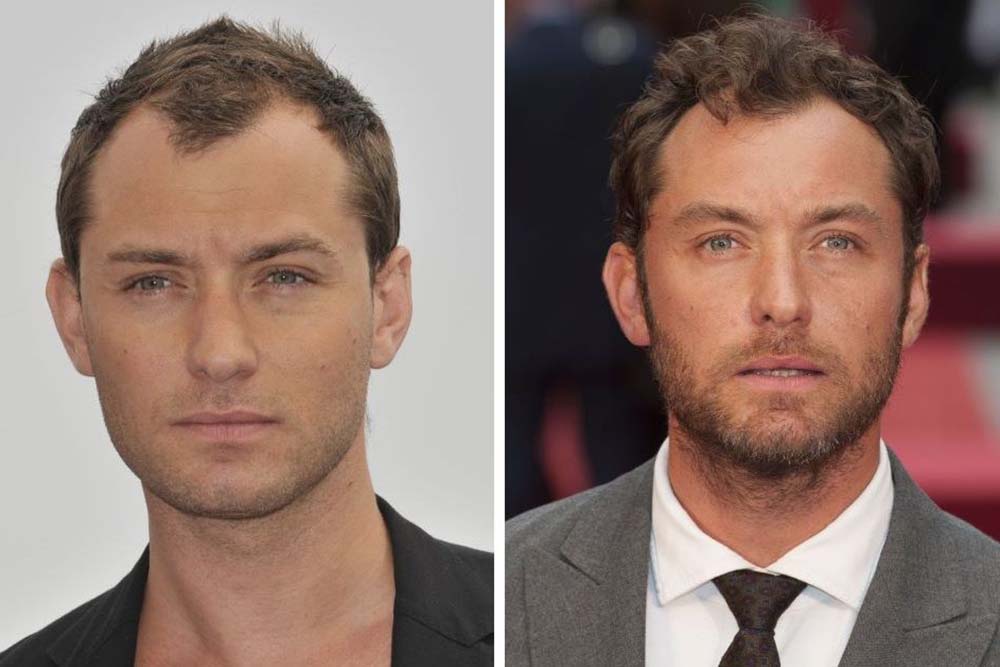
3. Jude Law — The Hairline That Raised Questions
Jude Law was widely considered one of the most attractive men in Hollywood in his prime. As his hair loss progressed through his 30s and into his 40s, it was widely covered in entertainment media. His response to that hair loss and the various stages of his hair appearance over the years generated significant discussion among hair restoration specialists.
At certain points his hairline appeared in a way that raised questions among experts about whether the work had been done well the positioning looked slightly off and the density was not entirely consistent with natural hair growth patterns. His more recent appearances show a considerably more refined and natural result which is widely attributed to revision and refinement work.
His case is a good example of how hairline design specifically, not just the transplant technique itself can make or break the final result. A technically good procedure with a poorly designed hairline still produces a result that looks wrong.
4. Antonio Conte — The Football Manager Whose Transplant Was Photographed Everywhere
Antonio Conte is one of the most successful football managers in the world and his hair transplant journey has been photographed and discussed more extensively than almost any other non-actor celebrity. Early photographs after his procedure showed a hairline that many transplant specialists described as overly aggressive, positioned too low and too straight for his age and facial structure.
The unnaturally straight and dense hairline was immediately noticeable and became a topic of considerable discussion in both football and beauty media. Over subsequent years his hairline appeared more refined and natural consistent with revision work being done to correct the original design and soften the artificial appearance of the initial result.
His case is particularly valuable as an educational example because it illustrates so clearly how hairline design is as important as surgical technique. The graft survival was clearly fine the density was there. But the design was wrong and that made everything look off.
Signs of a Failed Transplant vs a Good One
What You See | Bad Transplant | Good Transplant |
Hairline Shape | Perfectly straight, ruler-like line | Natural, slightly irregular with soft transition |
Hair Density | Patchy, uneven, or unnaturally uniform | Gradually increasing density from front to back |
Individual Grafts | Visible clusters or pluggy groups | Natural-looking single and multi-hair groupings |
Donor Area | Visible linear scar or over-harvested patches | Clean donor zone, no visible scarring |
Overall Look | Obviously done, artificial at close range | Indistinguishable from natural hair growth |
Long Term Result | Worsens as surrounding natural hair falls | Stable and consistent as years go on |
Why Revision Hair Transplants Become Necessary
Reason for Revision | How Common | Can It Be Fixed |
Poor hairline design too straight or too low | Very common in budget clinics | Yes through careful graft removal and redesign |
Doll hair or pluggy appearance from old technique | Common in older procedures | Yes grafts can be broken up and redistributed |
Uneven density or patchy survival | Common with inexperienced surgeons | Yes additional grafts added to thin areas |
Visible donor scarring from poor FUT technique | Moderately common | Yes FUE grafts can be used to camouflage scars |
Hairline too aggressive for age and future loss | Common when long term planning ignored | Partially requires careful management and planning |
Shock loss without recovery | Less common but serious | Often yes with PRP therapy and possible re-grafting |
Cost of Hair Transplant Repair Treatment in Delhi
Type of Revision Needed | Approximate Cost in INR | What Is Involved |
Minor hairline refinement | ₹40,000 – ₹80,000 | Small number of grafts to soften and correct hairline |
Density correction for patchy areas | ₹80,000 – ₹1,50,000 | Additional FUE grafts placed into thin areas |
Full revision of poor previous transplant | ₹1,50,000 – ₹3,50,000 | Complete reassessment, redesign, and re-transplantation |
When it comes to fixing a hair transplant that went wrong, the choice of clinic and surgeon is even more critical than it was the first time. You are not starting from scratch you are working with a scalp that has already been operated on, donor hair that has already been used, and scar tissue that needs to be carefully managed. This is not a procedure for a generalist or a budget clinic.
Dr. Nivedita Dadu is one of the most experienced dermatologists and hair restoration specialists at her clinic in Delhi. Revision and repair cases require a completely different level of assessment, planning, and technical execution compared to a first-time transplant. At Dr. Nivedita Dadu's clinic in Delhi, every revision case begins with a detailed scalp analysis examining the existing graft placement, remaining donor supply, scar tissue condition, and the realistic scope of what correction can achieve. If you have had a transplant that did not give you the result you expected and are looking for the best doctors in Delhi to assess your options, a consultation at the clinic is the most important step you can take right now.
What Happens During a Hair Transplant Repair Procedure
The process starts with a thorough evaluation that is significantly more detailed than a standard first-time transplant consultation. Your doctor will examine the existing grafts under magnification, assess the donor area to understand how much usable hair remains, evaluate any scarring, and give you an honest picture of what revision can realistically achieve.
Depending on what the revision involves, the procedure may include extracting poorly placed grafts and reimplanting them at correct angles and positions, adding new grafts from the donor area to fill in patchy or low-density zones, using FUE grafts to camouflage visible scarring from previous FUT procedures, or a combination of all of the above.
The recovery process after a revision treatment in Delhi is similar to a first-time transplant mild redness and scabbing for about a week, shedding of transplanted hair in the first month, and new growth beginning from month 3 with full results visible by month 9 to 12. The difference is that the final result corrects not just the hair loss but the mistakes of the previous procedure giving you the natural, well-designed result you should have had from the beginning.
Comments (0)
Loading comments...